

Do Google Business Profile Posts Actually Help You Rank? | Level Up Business
The honest answer, backed by data, not guesswork, and exactly how to use GBP posts as part of a local SEO strategy that actually moves the needle.
If you’ve been posting on your Google Business Profile every week and wondering whether it’s actually doing anything, you’re asking exactly the right question.
The short answer is: yes, but not in the way most people think. Google Business Profile (GBP) posts don’t directly push you up the Map Pack rankings the way a flood of reviews or strong citations might. But dismissing them as pointless would be a mistake, because used strategically, they contribute to a local SEO presence that gets results.
In this post, we’re cutting through the noise to give you the real picture: what GBP posts do (and don’t do) for your rankings, what the data actually says, and how to use them in a way that supports your broader SEO strategy.
First: What Are Google Business Profile Posts?
GBP posts are short content updates, similar to social media posts, that appear directly on your Google Business Profile in search results and Google Maps. They can include text, images, offers, events, or product highlights, and they typically expire after seven days (except Events and Offers, which run until their end date).
They show up when someone searches for your business by name, and sometimes in broader local searches depending on your profile’s authority and relevance. They’re free, quick to publish, and sit in one of the most valuable pieces of digital real estate on the internet, right inside Google Search itself.
So the question isn’t whether you should use them. The question is whether they actually move the needle on your rankings.
What Does the Data Actually Say?
Here’s the honest truth: GBP posts are not a confirmed direct ranking factor in Google’s local search algorithm. Google has never officially stated that posting frequency or post engagement directly influences your position in the Map Pack or local organic results.
However, multiple SEO studies and local search experts, including research from BrightLocal and Whitespark’s annual Local Search Ranking Factors survey, consistently find that active, well-maintained profiles tend to outperform neglected ones. And posting is one of the clearest signals that a profile is actively managed.
What the research suggests:
Profiles that post regularly show higher engagement rates (clicks, calls, direction requests) than those that don’t. Higher engagement correlates with stronger local presence — even if posts aren’t a direct ranking lever.
The mechanism isn’t posts → rankings. It’s posts → engagement → signals → better visibility. That indirect chain still matters, especially in competitive local markets like Prescott, where every edge counts.
The Honest Breakdown: What Posts Do and Don’t Do
The takeaway: GBP posts are an engagement tool first, and an SEO support tool second. That’s not a reason to skip them, it’s a reason to use them with the right expectations and pair them with the tactics that actually drive ranking directly.
Is Your GBP Working as Hard as It Should?
Most Prescott businesses are leaving visibility, and revenue, on the table with an underoptimised Google profile. Our SEO Game Plan gives you a step-by-step local strategy built specifically for your market.
See the SEO Game Plan for Prescott Businesses
The 4 Ways GBP Posts Indirectly Support Your SEO
1. They Signal That Your Business Is Active
Google’s local algorithm favours businesses that are actively managed. Regular posting is one of the clearest indicators that a real, engaged business is behind the profile. This “freshness” signal isn’t enormous on its own, but it stacks with other activity like responding to reviews and keeping hours updated.
2. They Increase Profile Engagement
When a searcher sees an offer or event post on your profile and clicks through to your website, that’s a behavioural signal. When they call directly from a post CTA button, that’s a conversion signal. Google pays attention to how users interact with profiles, and a profile that drives clicks and actions is a profile that’s doing its job.
3. They Can Appear in Voice Search and Discovery
Posts with keyword-rich content have been observed appearing in “Near me” and discovery searches, not just branded searches. While this isn’t guaranteed, it creates an additional opportunity for your business to appear to potential customers who aren’t yet searching for you by name.
4. They Support Your Content Keyword Strategy
Every post you write is an opportunity to use location-specific and service-specific keywords naturally. Posts that mention "Prescott HVAC services," "bookkeeping for small businesses in Prescott," or your specific service areas reinforce the local relevance signals that Google uses to determine who to show in local results.
The Right Posts to Publish (and How Often)
Not all GBP posts are equal. The type of post, the content quality, and the consistency of your publishing schedule all affect how well your profile performs.
THE GOLDEN RULE
Every post should have a clear call to action and link somewhere useful, your website, a booking page, or a specific service page. Posts without CTAs are a missed opportunity to convert profile visitors into leads.
What Actually Drives Local Rankings (And How Posts Fit In)
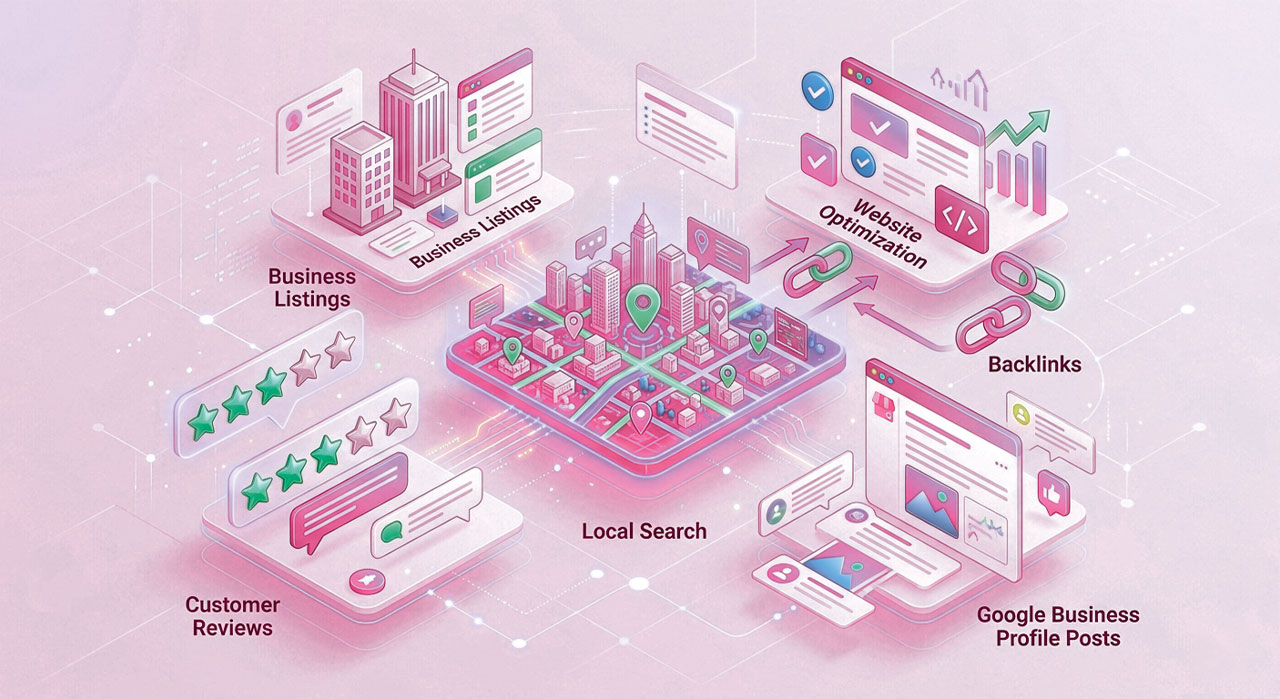
If you want to rank in the Map Pack and local organic results, here’s how the major factors stack up, and where GBP posts fit in the picture:
Google Business Profile completeness and accuracy (hours, category, services, photos) — High direct impact
Reviews: quantity, recency, and your responses — Very high direct impact
On-page local SEO (NAP consistency, location pages, schema markup) — High direct impact
Local citations and directory listings — Moderate direct impact
Backlinks from local and relevant websites — High direct impact
GBP posts — Indirect support via engagement signals
Posts sit at the bottom of this list in terms of direct ranking power, but they’re the one thing that ties the rest together. A fully optimised profile with great reviews and strong citations is more compelling, to both Google and potential customers, when it’s also actively posting. It’s the difference between a shop with a great sign and a shop that’s clearly open, active, and worth visiting.
Common GBP Post Mistakes to Avoid
Posting without a CTA. Every post should tell the reader what to do next.
Using the same post repeatedly. Duplicate content looks lazy to Google and uninteresting to users.
Ignoring photo quality. Blurry, dark, or irrelevant images reduce engagement and reflect poorly on your brand.
Posting and then going quiet for weeks. Consistency matters more than volume. Two posts a week, every week, beats a burst of ten posts then silence.
Writing for Google instead of people. Keyword-stuffed posts that read unnaturally will put off real visitors and won’t impress the algorithm either.
Forgetting to link. Posts without links back to your website miss the opportunity to build traffic and reinforce your site’s local relevance.
The Bottom Line
Google Business Profile posts won’t single-handedly rank your business at the top of the Map Pack. But they’re a low-effort, high-leverage tool that, when used consistently and strategically, supports everything else you’re doing for local SEO.
Think of your GBP as a living, breathing storefront on Google. Posts are what keep the lights on, the sign updated, and the door open. Ignore them, and your profile looks abandoned. Use them well, and they become a consistent source of clicks, calls, and conversions, all while quietly reinforcing the engagement signals Google uses to assess your local relevance.
In a competitive local market, “good enough” isn’t a strategy. Every active signal counts. GBP posts are one of the easiest ones to get right.
Want a Local SEO Strategy That Actually Works?
Level Up Business’s SEO Game Plan is built for Prescott businesses that are serious about ranking. We audit your Google Business Profile, identify your biggest ranking gaps, and give you a clear, prioritised plan to move up in local search, without the guesswork.