


Why Informational Blogs Drive Buyer Traffic (And How to Use Them for SEO)
Most small business owners think blogging is just for big brands with content teams and deep marketing budgets. But here's what the data actually shows: informational blog content is one of the most cost-effective ways to attract buyers, not just curious readers, but people actively moving toward a purchase decision.
If you're a local business owner trying to grow your online presence without wasting money on ads that stop working the moment you stop paying, this is the strategy you've been missing.
What Is Informational SEO Content (And Why Does It Matter)?
Informational SEO content refers to blog posts, guides, and articles that answer real questions your potential customers are typing into Google. These aren't sales pages, they're helpful resources that build trust before someone ever clicks "contact us."
Think about your own buying habits. Before you hire a contractor, buy new equipment, or choose a local service provider, you probably Google a few questions first. You read, compare, and research. That's the informational stage of the buyer's journey, and it happens before most businesses even know a potential customer exists.
When your blog shows up during that research phase, you're not just getting traffic. You're getting introduced to a future buyer at exactly the right moment.
The search intent behind informational content is enormous. According to SEO research, roughly 80% of all search queries are informational in nature. That's a massive pool of potential customers asking questions your business could be answering, right now.
The Buyer's Journey: Where Informational Blogs Fit In
Understanding why informational content drives buyer traffic starts with understanding how people actually make purchasing decisions. The buyer's journey typically moves through three stages:
1. Awareness — The person realizes they have a problem or need. They search for information to understand it better. ("Why is my HVAC running but not cooling?" or "What does a bookkeeper actually do?")
2. Consideration — They research their options and evaluate solutions. ("HVAC repair vs. replacement — what's the better investment?" or "Should I hire a bookkeeper or use accounting software?")
3. Decision — They're ready to buy and just need to choose who to trust.
Most businesses only create content aimed at the decision stage, service pages, pricing, and contact forms. But by the time someone reaches that stage, they've already formed opinions based on what they read earlier. If your blog wasn't there during awareness and consideration, a competitor's was.
Informational blogs put you in the room before the competition even shows up.
Ready to Turn Your Blog Into a Lead Machine?
5 Reasons Informational Blogs Drive Qualified Buyer Traffic
1. They Target Long-Tail Keywords with High Purchase Intent
Long-tail keywords are longer, more specific search phrases. "Plumber near me" is short-tail. "How much does it cost to replace a water heater in Prescott AZ" is long-tail, and the person typing that is much closer to making a hiring decision.
Informational blog posts are the perfect vehicle for capturing long-tail traffic. These keywords tend to have lower competition, meaning a local business can actually rank for them without spending thousands on SEO campaigns. And because they're specific, the people finding your blog through them are already highly qualified.
2. They Build Trust Before the First Contact
Trust is the currency of local business. Buyers want to hire people they feel they already know, like, and trust. An informational blog gives you a way to demonstrate expertise, answer questions honestly, and show your personality, all before anyone picks up the phone.
When a potential customer reads three of your helpful blog posts before booking a consultation, they don't arrive as a cold lead. They arrive pre-sold. They've spent time with your thinking. They believe you know what you're doing. That changes everything about the sales conversation.
3. They Generate Compounding, Long-Term Traffic
Unlike paid ads, a well-optimized blog post doesn't stop working when your budget runs out. It sits on Google and continues attracting traffic for months and years. This is what makes content marketing one of the highest-ROI strategies available to local businesses.
A single informational blog post ranking on page one of Google can generate hundreds of qualified visits per month, for free, indefinitely. Multiply that across 10, 20, or 50 posts, and you've built a traffic engine that runs on autopilot.
4. They Support Your Other SEO Efforts
Informational content doesn't just drive direct traffic, it strengthens your entire SEO foundation. Internal links from blog posts point visitors (and search engines) to your service pages. Backlinks from other sites quoting your content boost your domain authority. Fresh, regularly published content signals to Google that your site is active and relevant.
For local businesses especially, a consistent blogging strategy amplifies the effectiveness of every other SEO investment you've made, your Google Business Profile, your location pages, your reviews.
5. They Answer Objections Before the Sales Conversation
Every buyer has objections. Price concerns. Uncertainty about whether they really need what you offer. Doubt about whether your type of business can handle their specific situation. Informational content lets you address those objections proactively, in writing, at scale.
A blog post titled "Is It Worth Hiring a Local SEO Company? Here's the Honest Answer" does more to pre-qualify and pre-convert leads than almost any other piece of marketing you can create.
What Types of Informational Blog Posts Drive the Most Traffic?
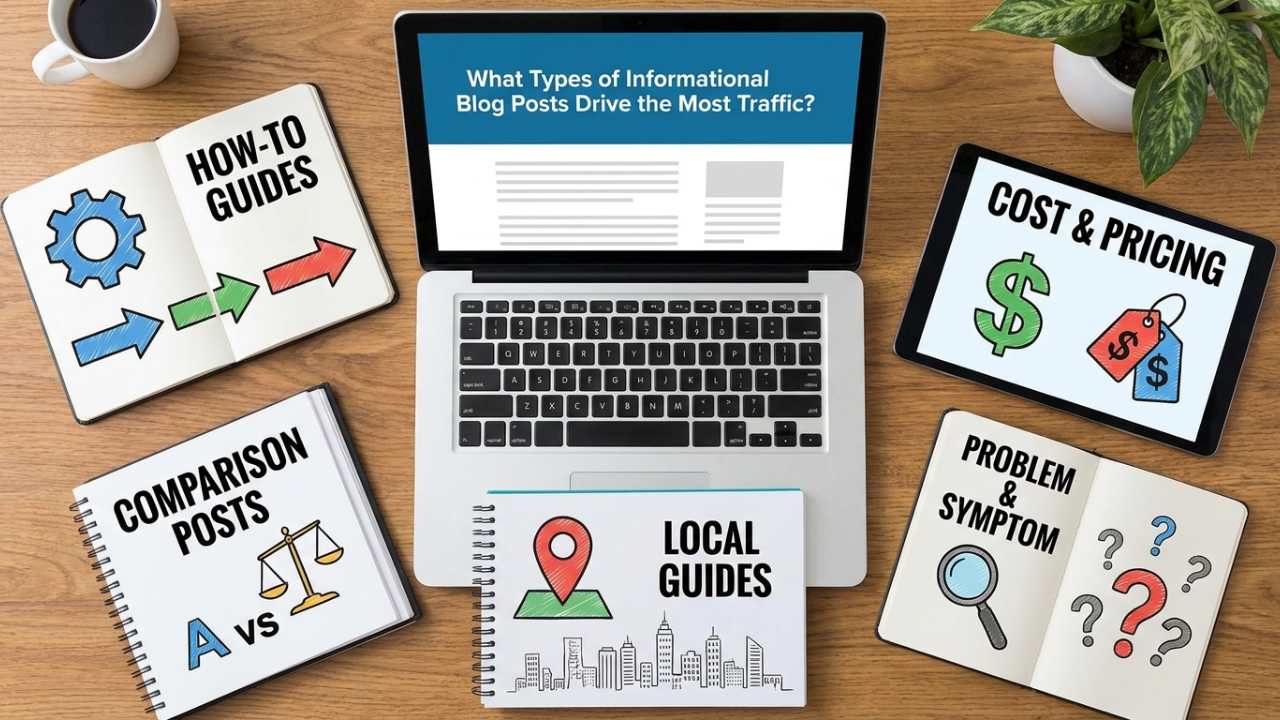
Not all informational content is created equal. The highest-performing posts for local businesses tend to fall into a few proven categories:
How-To and Tutorial Posts — Step-by-step guidance on something your audience wants to learn. These rank well because they directly match high-volume search queries.
Cost and Pricing Guides — "How much does [service] cost?" is one of the most common questions buyers ask. Answering it transparently on your blog builds trust and captures high-intent searchers.
Comparison Posts — Helping buyers weigh their options positions you as an honest advisor rather than a pushy salesperson. "Option A vs. Option B: Which Is Right for You?" is a proven format.
Local Guides and Area-Specific Content — For local businesses, writing content tied to your geographic area (your city, surrounding communities, local regulations, local trends) helps you rank in local searches and signals community relevance to Google.
Problem and Symptom Posts — People often search for symptoms before they search for solutions. ("Why does my lawn keep dying in summer?" → leads to lawn care inquiry.) Meeting them at the problem stage gets you in front of buyers before they've even started comparing vendors.
Not Sure Where to Start With Your Blog Strategy?
How to Make Your Informational Blog SEO-Optimized
Writing helpful content is only half the job. For your blog to drive buyer traffic, it needs to be discoverable, and that means following SEO best practices.
Target One Primary Keyword Per Post — Choose a specific keyword phrase that your ideal customer is likely to search. Use it naturally in your title, first paragraph, subheadings, and conclusion.
Write for Humans First, Search Engines Second — Google's algorithm has gotten remarkably good at identifying genuinely helpful content. Write clearly, stay on topic, and answer the question thoroughly.
Use Proper Heading Structure — Break your post into logical sections using H2 and H3 headings. This improves readability and helps search engines understand your content's structure.
Include Internal Links — Link from your blog posts to relevant service pages, related posts, and your contact page. This keeps readers engaged and distributes SEO value across your site.
Optimize Your Meta Title and Meta Description — These are the first things a searcher sees in Google results. Make them compelling, accurate, and include your target keyword naturally.
Write Long-Form Content When Appropriate — For competitive topics, longer, more comprehensive posts tend to outrank thin content. Aim for depth and completeness, not just word count.
Add a Clear Call to Action Every informational post should include at least one invitation for the reader to take a next step: book a call, download a guide, or explore your services.
The Local Business Advantage: Why This Works Even Better for You
National brands compete in enormously crowded content spaces. Local businesses, by contrast, operate in a much smaller competitive arena. In most local markets, the bar for content quality is remarkably low, meaning a consistent, well-written blog can put you at the top of local search results faster than you'd expect.
Your competitors are probably not blogging. Or if they are, they're publishing thin, generic content that doesn't genuinely help anyone. That's your opportunity.
A local HVAC company in a mid-sized market that publishes 2–4 strong informational posts per month can realistically dominate its local search landscape within 12–18 months. The businesses that start now will own that territory. The ones that wait will be playing catch-up against established content.
Let Level Up Handle the Blogging While You Run Your Business
Frequently Asked Questions
Q: How long does it take for informational blog posts to drive traffic?
A: Most well-optimized blog posts begin ranking within 3–6 months. The timeline varies based on your domain's existing authority, the competitiveness of your target keywords, and how consistently you publish. Local businesses with less established competition often see results on the faster end of that range. The key is consistency — blogging is a compounding strategy, not an overnight fix.
Q: How often should a local business publish blog content?
A: For most local businesses, 2–4 posts per month is a realistic and effective cadence. Quality matters more than frequency — one excellent, well-researched 1,500-word post will outperform four thin 300-word posts every time. The goal is to build a library of genuinely useful content over time.
Q: Can informational blogs really compete with paid advertising?
A: They serve different purposes — but for sustained, long-term lead generation, blogging often delivers better ROI. Paid ads stop the moment you stop paying. A well-ranking blog post continues attracting buyers for years. Many businesses find that a combination of both works best: paid ads for immediate results, content marketing for long-term compounding growth.
Q: What if I don't have time to write blog posts?
A: You don't have to. Done-For-You SEO blogging services — like the one offered by Level Up Business — handle everything from keyword research and writing to optimization and publishing. You provide your expertise; the content team translates it into traffic-driving blog posts that sound like you.
Q: Do I need a large website to benefit from blogging?
A: Not at all. Even a simple, well-structured local business website can benefit enormously from a consistent blog. In fact, smaller sites often see faster gains because each new post represents a significant expansion of their indexed content, which signals growth and relevance to Google.
The Bottom Line: Informational Content Is a Buyer Traffic Strategy
Informational SEO blogging isn't about showing off how much you know. It's about showing up where your buyers are already looking, before they've chosen a provider, before they've even fully defined the problem, and being the most helpful, trustworthy voice in the room.
For local businesses, this is one of the most powerful and underutilized growth strategies available. It costs far less than paid ads, delivers compounding returns over time, builds brand authority in your community, and consistently attracts the kind of qualified leads that convert into paying customers.
The question isn't whether informational blogging works. It does. The question is whether your business is doing it, and if not, how much traffic and how many buyers you're letting your competitors capture instead.
Level Up Business helps local small businesses build content strategies that attract real buyers, not just readers. From keyword research to fully written and published posts, we make it simple to grow your online presence without burning out.
Book a Free Strategy Meeting Today