

What Are Local Citations and Do They Still Matter for SEO?
If you’ve spent any time researching local SEO, you’ve probably come across the term “local citations.” Maybe someone told you to “build more citations” or you saw it on a checklist somewhere. But what does that actually mean, and does it still move the needle in 2025?
The honest answer: yes, local citations still matter. But not in the way most business owners think. The game has changed, and if you’re still playing it the old way, blasting your business info to 200 random directories and calling it done, you’re wasting time.
This guide breaks down what local citations actually are, why they still influence your Google ranking, and what a smart citation strategy looks like for a local business right now.
What Is a Local Citation, Really?
A local citation is any online mention of your business’s core information: your Name, Address, and Phone number. You’ll often see this referred to as “NAP data.” These mentions can show up on business directories like Google Business Profile, Yelp, Facebook, and Bing Places, but also on local Chamber of Commerce websites, industry-specific platforms, news articles, blog posts, and data aggregators that feed information to dozens of other sites.
There are two main types of citations:
Structured citations, formatted listings on directories and platforms (Google Business Profile, Yelp, Yellow Pages, Houzz, Healthgrades, and so on).
Unstructured citations, mentions of your business in articles, blog posts, local news coverage, or social media that include your NAP information, even if it’s not in a traditional directory format.
Both types send signals to Google about who you are, where you are, and whether your business is real and trustworthy. That’s what makes them relevant to local SEO.
Why Local Citations Matter for Your Google Ranking
Google’s local search algorithm, the one that determines who shows up in the Map Pack, that coveted box of three local businesses at the top of search results, takes into account several factors. Citations are one of them.
Here’s the core logic: Google is trying to surface businesses it can trust. When it sees your business name, address, and phone number listed consistently across dozens of reputable sources, that consistency acts as a trust signal. It confirms that your business is legitimate, established, and located where you say it is.
The data backs this up:
Local citations are among the top factors influencing local pack rankings, according to industry research from Whitespark and BrightLocal.
Businesses with consistent, accurate citations across major platforms tend to rank higher in local search than businesses with incomplete or inconsistent listings.
Citation inconsistency, different phone numbers, old addresses, mismatched business names, can actively hurt your local SEO by confusing search engines and customers alike.
That last point is where a lot of small businesses quietly lose ground. It’s not always about having more citations. It’s about having accurate ones.
Not Sure Where Your Citations Stand?
Level Up Business offers a free local SEO strategy session where we audit your citation health and show you exactly what’s hurting your ranking.
Book Your Free Strategy Meeting
Do Local Citations Still Matter in 2025?
Short answer: yes, but their role has evolved.
A few years ago, the local SEO playbook was simple: submit your business to as many directories as possible and watch your ranking climb. Directory quantity was king. Those days are largely gone.
Google has gotten smarter. It now places more weight on the quality and consistency of your citations than on the sheer number of them. A listing on a spammy, low-authority directory does nothing for your ranking, and may actually introduce inconsistencies that hurt it.
What still matters in 2025:
Being listed on high-authority platforms (Google Business Profile, Yelp, Facebook, Bing Places, Apple Maps).
Having accurate, consistent NAP data across all major directories and data aggregators.
Getting listed on industry-specific platforms relevant to your niche (Houzz for home services, Healthgrades for healthcare, Avvo for legal, TripAdvisor for hospitality).
Earning citations from local sources, city directories, local news sites, Chamber of Commerce pages, which carry strong geographic relevance signals.
What matters less: being listed on 300 generic directories nobody visits. Volume without quality is noise.
The Real Citation Problem Most Local Businesses Have
It’s not that local businesses don’t have citations. Most do, often more than they realize. The problem is that those citations are a mess.
Think about everything that can go wrong over the life of a local business: you change your phone number, move to a new location, update your hours, rebrand slightly. Each of those changes creates an opportunity for your citation data to become inconsistent across the web.
And once that inconsistency spreads, across Yelp, Apple Maps, data aggregators like Foursquare and Data Axle, and dozens of directories that pull from those aggregators, it’s hard to clean up without a systematic approach.
The most common citation problems local businesses face:
Duplicate listings on the same platform with conflicting information.
Old addresses or phone numbers still live on platforms you forgot you claimed.
Slight name variations ("ABC Plumbing" vs. "ABC Plumbing & Heating" vs. "ABC Plumbing LLC") that confuse search engines.
Missing citations on platforms where your competitors are listed, gaps that cost you visibility.
Unclaimed listings you didn’t create, filled with incorrect auto-populated data.
Each of these issues quietly erodes your local SEO performance. The fix isn’t always adding more citations, it’s auditing and cleaning up the ones you already have.
The Platforms That Actually Matter
Not all citation sources carry equal weight. Focus your energy where it counts most.
Tier 1: Non-Negotiables
These are the platforms Google trusts most and that your customers check first. Every local business should be fully claimed and optimized here:
Google Business Profile
Yelp
Facebook Business Page
Bing Places for Business
Apple Maps
Tier 2: High-Authority General Directories
These carry strong domain authority and feed data to other directories:
Better Business Bureau (BBB)
Yellow Pages (YP.com)
Foursquare (a major data aggregator)
Angi (formerly Angie’s List)
MapQuest
Tier 3: Industry-Specific Platforms
These vary by your niche but carry powerful relevance signals for local search:
Home Services: Houzz, HomeAdvisor, Thumbtack
Healthcare: Healthgrades, Zocdoc, WebMD
Legal: Avvo, FindLaw, Martindale-Hubbell
Hospitality: TripAdvisor, OpenTable
Fitness: Mindbody, ClassPass
You don’t need to be everywhere. You need to be listed accurately on the platforms that matter to your industry and your customers.
Want to Know Which Platforms Matter for Your Business?
Level Up Business builds done-for-you local SEO game plans that cover citation audits, listing optimization, and everything in between.
How to Build and Clean Up Your Local Citations
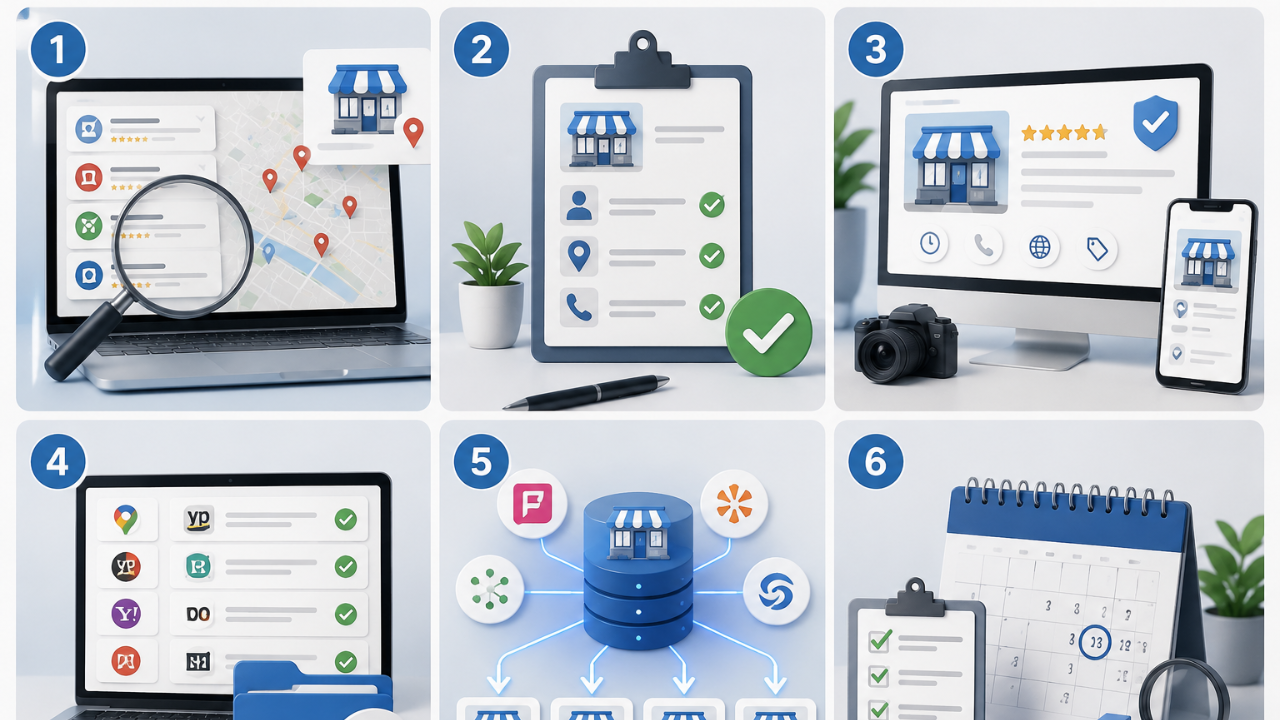
Whether you’re starting from scratch or cleaning up a citation mess you inherited, here’s a practical framework:
Step 1: Audit Your Current Citations
Search your business name, address, and phone number across major platforms. Look for inconsistencies, duplicates, and old information. Tools like BrightLocal, Whitespark, or Moz Local can automate much of this process, but a manual spot-check on Google, Yelp, Facebook, and Bing is always worth doing.
Step 2: Standardize Your NAP Data
Before you update or create any listings, decide on the exact format you’ll use for your business name, address, and phone number, and stick to it everywhere. Even small variations ("St." vs. "Street," "Suite" vs. "Ste") can create inconsistencies that weaken your citation signals.
Step 3: Claim and Optimize Priority Listings
Start with Tier 1 platforms. Make sure each listing is claimed, verified, and fully complete, accurate hours, business description, categories, photos, and website link. An incomplete listing is a missed opportunity.
Step 4: Submit to High-Authority Directories
Work through Tier 2 directories and any industry-specific platforms relevant to your business. Focus on quality over volume. A fully completed listing on a high-authority site is worth far more than a partial listing on fifty low-authority ones.
Step 5: Address Data Aggregators
Data aggregators like Foursquare, Data Axle, and Neustar Localeze push your business information to hundreds of other directories. Correcting your data at the aggregator level creates a multiplier effect that cleans up downstream listings automatically.
Step 6: Monitor Ongoing
Citations can change without your knowledge. New duplicates get created, old data resurfaces, platforms update their information. Build a process for reviewing your key listings quarterly to catch issues before they compound.
Common Citation Mistakes Local Businesses Make
Using different versions of your business name. Pick one and stick to it. "Smith’s HVAC", "Smith HVAC Services", and "Smith’s Heating & Cooling" are three different businesses to a search engine.
Ignoring citations after a move or rebrand. When your business information changes, your citations need to change with it, on every platform. This is often where citation chaos begins.
Chasing quantity over quality. Mass-submitting to low-authority directories is time wasted. Focus your energy on platforms that actually influence ranking and customer discovery.
Leaving listings unclaimed. Unclaimed listings are filled with auto-populated data that may be wrong. Claiming them gives you control over what potential customers see.
Not adding photos, descriptions, or categories. A bare-bones listing is a wasted listing. Fully optimized profiles outperform empty ones in both search ranking and click-through rate.
How Long Does It Take to See Results?
Citation building and cleanup is not an overnight fix. Here’s a realistic timeline:
Within 30 days: Major platform updates (Google, Yelp, Facebook) are live and being crawled.
Within 60–90 days: Data aggregator corrections begin propagating to downstream directories.
Within 3–6 months: You should see meaningful improvement in local search visibility, particularly if you combined citation work with a strong Google Business Profile and consistent review generation.
The compounding effect is real. Strong citations support your Google Business Profile ranking, which supports your review visibility, which drives more customers, which generates more reviews. It’s a flywheel, and citations are one of the first things you need to get spinning.
Frequently Asked Questions
Are local citations the same as backlinks?
Not exactly, though they’re related. Backlinks are links from other websites to yours, they influence your overall domain authority. Citations are mentions of your NAP information, with or without a link. Both matter for local SEO, but citations specifically target local ranking signals while backlinks have a broader SEO impact.
Do I need a physical address to build citations?
You need a consistent, verifiable address, but it doesn’t have to be a public storefront. Service-area businesses can hide their street address on Google Business Profile while still maintaining consistent NAP data elsewhere. Just make sure whatever address you use is stable and matches across all platforms.
Can I build citations myself or do I need a service?
You can absolutely do it yourself, but it’s time-consuming to do well. Auditing dozens of platforms, fixing inconsistencies, submitting to aggregators, and monitoring ongoing changes adds up quickly. Many local businesses find it more efficient to work with a local SEO partner who handles citations as part of a broader strategy.
How many citations do I need?
There’s no magic number. The goal is accurate, complete listings on the platforms that matter for your industry and location, not hitting a specific count. Focus on quality and consistency first. If your priority platforms are all accurate and optimized, you’re ahead of most of your local competitors.
What happens if I have duplicate listings?
Duplicates create confusion, for search engines and for customers. Google may split your review history across multiple listings, or show customers outdated information. The fix is to claim and merge duplicates where possible, or request removal through each platform’s support process.
Ready to Take Control of Your Local Search Presence?
Level Up Business helps local businesses build, manage, and grow their online visibility, from citation cleanup to full local SEO game plans. No fluff, just results.