

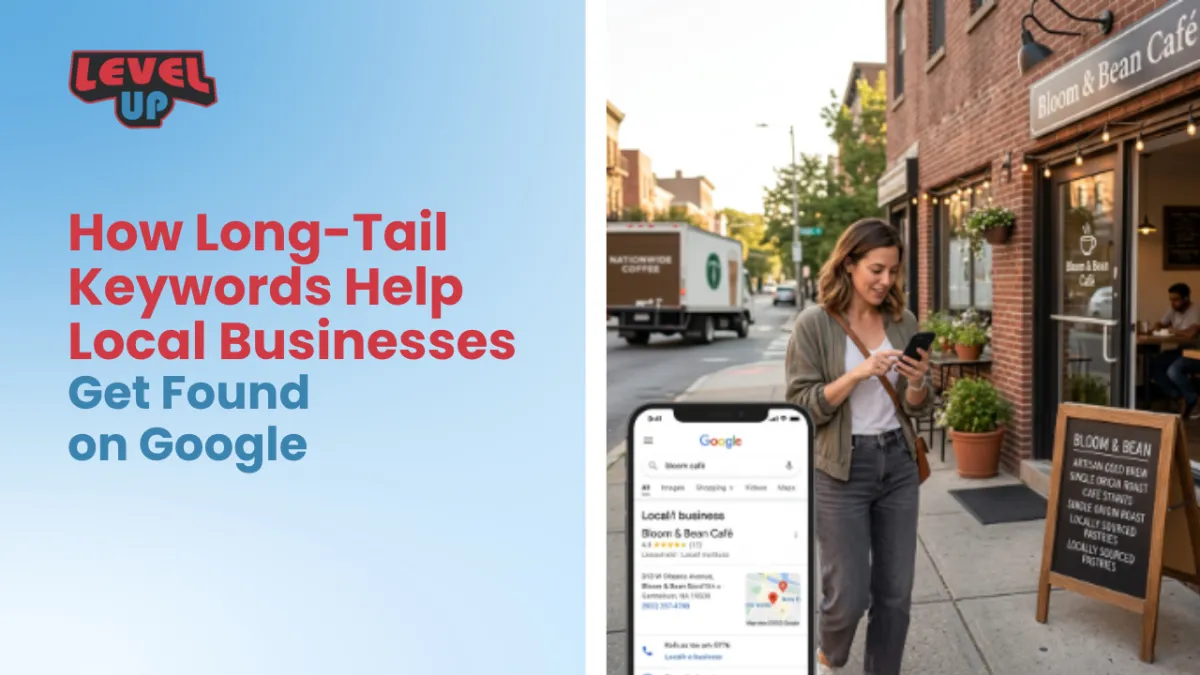
How Long-Tail Keywords Help Local Businesses Get Found on Google
If you run a local business, you've probably heard that you need to "rank on Google." But if you're only chasing broad, high-competition terms like "plumber" or "gym," you're fighting an uphill battle against national brands and franchises with massive marketing budgets. The smarter path, especially for small and mid-sized businesses, is long tail keywords for local SEO.
Long-tail keywords are longer, more specific search phrases that match exactly what a nearby customer is typing into Google when they're ready to take action. They don't get the search volume of generic terms, but they convert far better, face less competition, and are much easier to rank for. In this guide, we'll break down what long-tail keywords are, why they matter for local visibility, and how to start using them to get your business found by the people who are actually looking for you.
What Are Long-Tail Keywords, Exactly?
A "short-tail" keyword is broad and generic, think "coffee shop" or "auto repair." These terms get a lot of searches, but they're also incredibly competitive, and the searcher's intent is unclear. Are they looking for a coffee shop to open one, write about one, or visit one right now?
A long-tail keyword is longer and far more specific, such as:
"best coffee shop with wifi in downtown Prescott"
"24 hour auto repair shop near me open now"
"affordable personal trainer for beginners in [your city]"
These phrases usually contain three or more words, often include a location, and reflect a searcher who knows exactly what they want. That specificity is exactly why long-tail keywords are so valuable for local businesses.
Why Long-Tail Keywords Matter for Local SEO
1. Lower Competition, Higher Rankings
Ranking for "landscaping" against every landscaping company in the country is nearly impossible for a local business. But ranking for "drought-tolerant landscaping design in [your city]" is realistic, because far fewer businesses are targeting that exact phrase. With a Low difficulty score and solid monthly search interest, keywords like these represent the sweet spot: real demand without the impossible competition.
2. Higher Conversion Rates
Long-tail searchers tend to be closer to making a decision. Someone searching "cost to replace a water heater in [city]" isn't casually browsing, they likely have a broken water heater and need a solution today. That intent translates directly into phone calls, form submissions, and booked appointments.
3. Better Match for Voice and Mobile Search
More customers are searching by voice through phones and smart speakers, and those searches are naturally conversational and long-tail, "who's the best local SEO company near me" instead of just "SEO company." Optimizing for long-tail phrases positions your business to capture this growing segment of search traffic.
4. Stronger Signals for Google's Local Algorithm
Google rewards relevance and specificity. When your website content, service pages, and Google Business Profile consistently use specific, localized language, it sends clear signals about what you do and where you do it, helping you show up in the local map pack and organic results for the searches that matter most.
How to Find the Right Long-Tail Keywords for Your Business
You don't need expensive software to get started. Here are practical ways to uncover long-tail opportunities:
Google Autocomplete: Start typing a service + your city into Google and see what it suggests.
"People Also Ask" boxes: These reveal the exact questions real customers are searching.
Google Business Profile Insights: Review the search terms already driving traffic to your listing.
Customer language: Pay attention to the exact words customers use when they call or email you, that's often the same language they typed into Google.
Competitor content: See what specific phrases competitors are ranking for, then find the gaps they've missed.
Once you have a list, prioritize keywords with three key traits: reasonable search volume, low competition, and clear local intent (city, neighborhood, or "near me" language).
Where to Use Long-Tail Keywords on Your Website
Finding the keywords is only half the job, they need to be placed strategically to actually move the needle:
Page titles and meta descriptions, Make it obvious what the page offers and where.
Service pages Create dedicated pages for specific services and locations rather than one generic page trying to cover everything.
Blog content Answer specific customer questions in long-form posts (like this one).
Headers (H2s and H3s) Break up content using natural, keyword-rich subheadings.
Image alt text and file names Small detail, real impact.
Google Business Profile posts and Q&A Extend your keyword strategy beyond your website.
A well-structured local SEO game plan ties all of these elements together so your rankings build steadily instead of relying on guesswork.
Long-Tail Keywords Work Best as Part of a Bigger Strategy
Long-tail keywords are powerful, but they don't operate in a vacuum. They perform best when paired with:
A fast, well-structured website that's actually built to convert the traffic they bring in
Consistent, fresh content, which is exactly what monthly SEO blogging is designed to deliver
A steady stream of positive reviews, since online reputation management directly influences local rankings and trust
Reliable follow-up so leads generated from search don't fall through the cracks, which is where marketing and sales software comes in
When these pieces work together, long-tail keywords stop being a minor SEO tactic and become a consistent source of qualified, ready-to-buy local traffic.
Common Mistakes to Avoid

Keyword stuffing: Cramming a phrase repeatedly into a page hurts readability and can hurt rankings too. Write naturally.
Ignoring location variation: Customers search by neighborhood, city, and "near me" don't rely on just one geographic term.
One page trying to rank for everything: Split distinct services and locations into their own focused pages.
Neglecting your Google Business Profile: It's one of the most powerful (and free) tools for local long-tail visibility.
Giving up too soon: Long-tail rankings often build over weeks and months of consistent content, not overnight.
The Bottom Line
Long-tail keywords for local SEO give small businesses something rare in digital marketing: a genuine, achievable path to ranking on Google without competing directly with national brands. They connect you with customers who are specific, nearby, and ready to buy exactly the kind of traffic that turns into real revenue.
If you're not sure where to start, Level Up Business helps local business owners build SEO strategies, high-converting websites, and content systems designed around exactly this kind of keyword research.
Ready to get found by the customers actually searching for you? Book a free strategy meeting and let's map out a long-tail keyword plan built around your business and your city.
FAQs
What is a long-tail keyword in local SEO?
A long-tail keyword is a longer, more specific search phrase often including a location or service detail that reflects exactly what a nearby customer is looking for, such as "emergency plumber open on weekends in [city]."
Why are long-tail keywords easier to rank for than short-tail keywords?
Because they're more specific, fewer websites are competing directly for them. This makes it realistic for a local business to rank on page one, even against larger competitors with bigger budgets.
How many long-tail keywords should a local business target?
There's no fixed number, but most businesses benefit from targeting a handful of long-tail keywords per service page and continuing to expand through ongoing blog content that answers new customer questions.
Do long-tail keywords help with Google's local map pack, not just organic results?
Yes. Using specific, localized language consistently across your website and Google Business Profile helps Google understand your relevance to nearby searches, which can improve both map pack and organic visibility.
How long does it take to rank for long-tail keywords?
It varies, but because competition is lower, many local businesses start seeing movement within a few weeks to a couple of months of consistent optimization, faster than typically expected for broad, high-competition terms.