

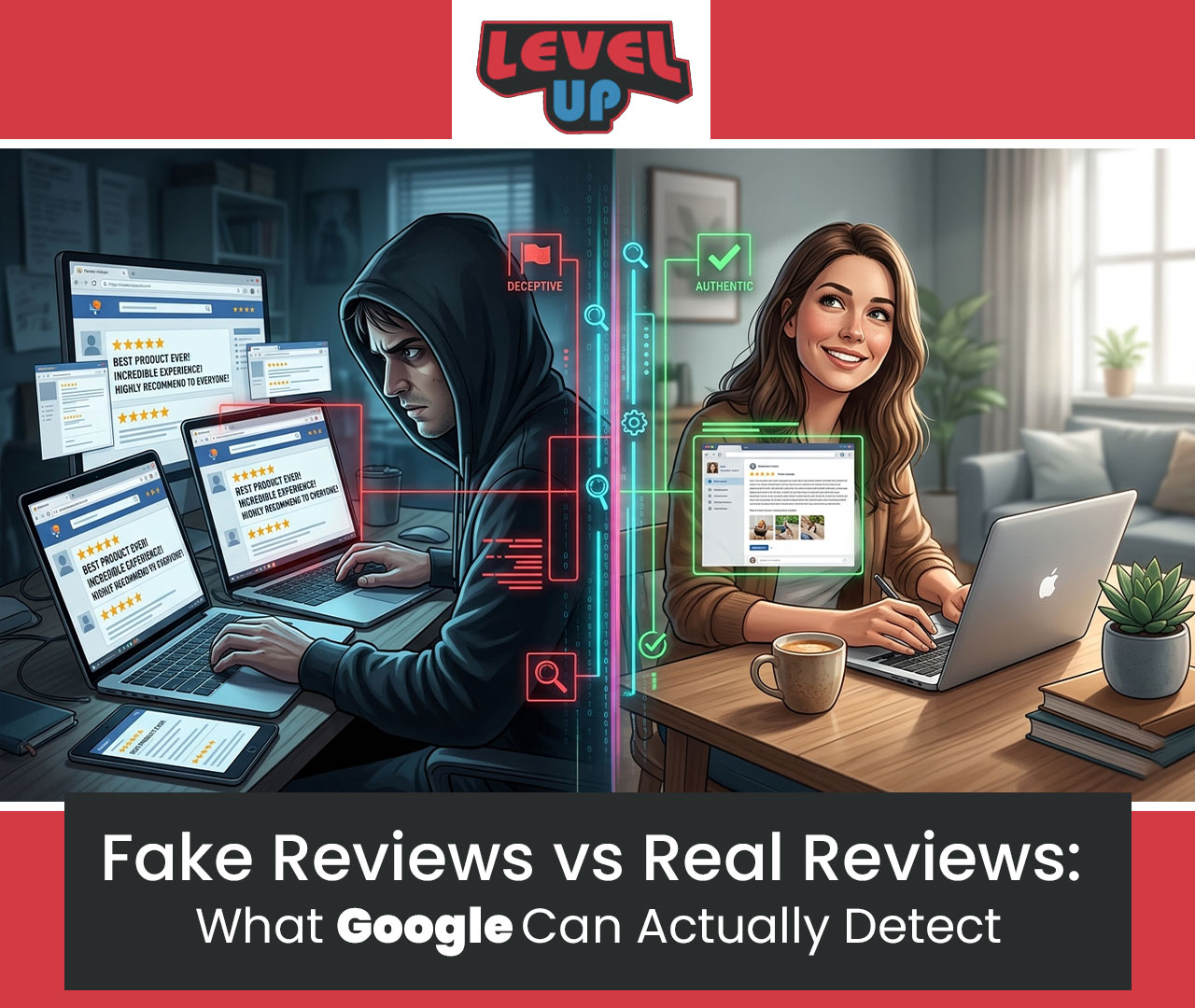
Fake Reviews vs Real Reviews: What Google Can Actually Detect | Level Up Business
Let's be honest,building up your Google review count the right way feels slow. You're doing great work, your customers are happy, but getting them to actually leave a review? That's a whole other battle.
So it's tempting. You see competitors sitting at 4.8 stars with 200 reviews and wonder how they got there so fast. Maybe someone even slides into your inbox offering 50 five-star reviews for $99. It looks like a shortcut. It sounds harmless.
It isn't.
Google has quietly become one of the most sophisticated review-screening systems on the internet,and what it can detect would genuinely surprise most small business owners. Before you even consider taking the fake review route (or if you're worried a competitor is using it against you), here's exactly what's happening behind the scenes.
Ready to Build a Review Strategy That Actually Works?
Why Google Cares SoMuch About Review Authenticity
Google's entire value as a search engine depends on trust. If people stop believing the reviews they read on Google Maps and Business Profiles, they stop using Google to make local purchasing decisions. That's an existential threat to Google's business model.
That's why Google doesn't treat fake reviews as a minor nuisance. They treat it as a direct attack on their platform,and they've invested heavily in stopping it.
The numbers back this up. In 2023, Google blocked over 170 million fake reviews, a 45% increase in detection accuracy compared to the previous year. By 2024, that number climbed even further, with Google blocking or removing more than 240 million policy-violating reviews,the vast majority before they were even seen by a single user.
This is not a system that's occasionally catching bad actors. This is a machine that's running 24/7, at scale, specifically built to catch exactly what review-buying services are selling.
What Google's Detection System Actually Looks For
Google uses a layered approach that combines artificial intelligence, machine learning, and human review teams. Understanding each layer helps you see why fake reviews are so much harder to hide than people think.
1. AI and Machine Learning Models
Google's automated systems scan every review before it's published,and continue scanning reviews that are already live. These models are trained to catch patterns that don't match how real customers behave. Google has even integrated Gemini AI into this process, which needs only a handful of examples to identify suspicious behavior across millions of listings in multiple languages.
What do these models look for? Unusual spikes in review volume, especially when multiple reviews arrive in a short window. Similar wording or sentence structure across reviews from different accounts. Overly emotional language,whether that's excessive positivity like "best experience ever, life-changing, absolutely perfect" or dramatic negativity that reads more like a personal attack than genuine feedback. Reviews that never mention specific details about the service, the staff, the location, or the actual experience.
Real customers talk like real people. Fake reviews, even well-written ones, tend to have a flatness to them,or an over-the-top quality,that the algorithms are trained to flag.
2. Behavioral and Account Analysis
Google doesn't just look at what a review says. It looks at who wrote it and how they've behaved across the entire platform.
An account that was created last week and has already left 12 five-star reviews for businesses in three different cities is going to get flagged. An account that only reviews businesses in a single industry niche, or that leaves reviews for businesses that are geographically impossible to have all visited, raises red flags. Accounts with no profile photo, no review history, and no engagement with Google Maps in any other way are signals the system watches closely.
Google essentially builds a credibility score for every reviewer. Fake review farms often churn out fake "Local Guide" accounts to make them seem more legitimate,but Google's behavioral analysis goes deeper than a badge.
3. Real-Time Monitoring
If your business suddenly receives 30 reviews in a 48-hour period after averaging two reviews a month for the past year, Google notices immediately. The system monitors velocity,how quickly reviews come in relative to your historical baseline. A sudden flood of positive reviews, especially from new or low-activity accounts, can trigger an automatic hold on your profile, a warning to users, or removal of the offending reviews entirely.
In one documented case, a local bar in Missouri was targeted with a flood of fake one-star reviews. Google's system detected the pattern, temporarily disabled the rating function for that business, removed the violating reviews, and investigated the accounts responsible,all without the business owner having to do much at all.
4. Intelligent Text Matching
Google has disclosed that it uses a system called "intelligent text matching" to identify reviews that are copied, rephrased, or clearly templated. Review farms often use spin software to slightly change the wording of the same review before posting it across multiple accounts. Google's system catches this. It can identify structural similarities even when the surface-level words are different.
5. Human Reviewers
Beyond the AI, Google employs dedicated teams of human reviewers who examine flagged content. When automated systems catch something suspicious but aren't certain, a real person takes a look. These reviewers are specifically trained to assess patterns of manipulation and can act on what they see,including escalating cases that warrant account suspension or legal action.
Google has even gone as far as filing lawsuits against organized review fraud operations, using what they learned from those cases to retrain their detection models.
What Happens to Your Business If You Get Caught
The consequences aren't just a slap on the wrist. Here's what Google can and does do when fake review activity is detected on a business profile.
Fake reviews get removed, sometimes in bulk. If a pattern is detected, every review associated with that pattern can disappear overnight, leaving you worse off than when you started.
Google can display a public warning on your Business Profile informing customers that fake reviews have been removed. This is visible to everyone searching for your business.
Your profile can receive restrictions that limit new reviews, edits, or functionality. In serious cases, Google can suspend your Business Profile entirely,which means disappearing from Google Maps and local search results.
The FTC added a new layer of legal risk in 2024 with its Final Rule on Consumer Reviews and Testimonials. Under this rule, businesses can face significant financial penalties for buying, soliciting, or posting fake reviews. This isn't just a Google problem anymore. It's a regulatory one.
And beyond the official consequences, there's a practical reality: customers are getting smarter. Research suggests that 62% of consumers believe they've encountered fake reviews in the past year. When someone suspects your reviews are manufactured, the trust damage to your brand can be harder to repair than a lower star rating ever would have been.
What Makes a Real Review Look Real (And Why It Matters)
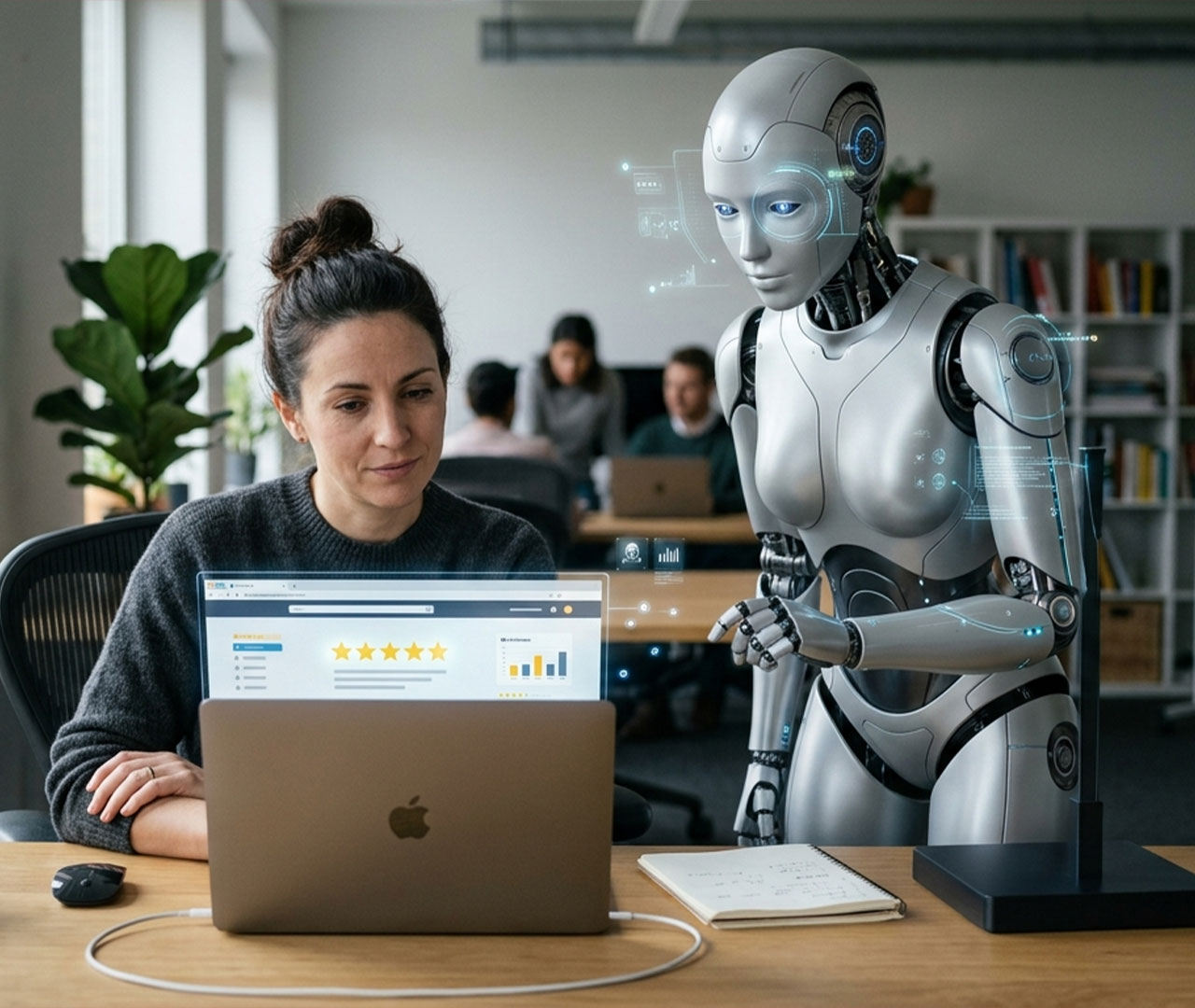
Understanding what Google values in a genuine review can also help you encourage better reviews from your actual customers.
Authentic reviews typically mention specific details,the name of a team member who helped them, the exact service they used, a particular moment that stood out. They're written in natural language, with normal grammar variation and a personal tone. They come from accounts that have other reviews on other businesses, photos, profile information, and some history on the platform. They arrive at a natural pace,one here, two there, spread out over weeks and months.
They're also diverse. Real customers give a range of ratings. A profile with 200 reviews that's a perfect 5.0 across the board actually raises suspicion,both with Google's algorithms and with increasingly skeptical customers who know perfection isn't realistic.
When you build reviews the right way, you get all of this organically. You get reviews that stick. Reviews that rank. Reviews that actually convert browsers into buyers.
How to Build Real Reviews Without Chasing Every Customer
You don't need to be awkward about asking for reviews. Most satisfied customers are genuinely happy to leave one,they just don't think of it in the moment, and they don't want friction.
The most effective approach is timing and simplicity. Ask right after a positive interaction, not days later when the moment has passed. Make it easy with a direct link to your Google review page,QR codes on receipts, a link in your follow-up text or email, a simple "we'd love your feedback" message sent the same day as service completion.
At Level Up Business, we help local businesses automate this process without it feeling automated. Our Marketing & Sales Software integrates with your customer communications so that review requests go out at the right moment, to the right people, through the right channel,whether that's SMS, email, or even a follow-up message through your CRM.
The businesses using this system consistently see more reviews, better-quality reviews, and a stronger local search presence,because Google rewards profiles that grow naturally and consistently over time.
What If a Competitor Is Using Fake Reviews Against You?
Fake reviews aren't just a temptation,they're also a weapon some unscrupulous competitors use to damage your reputation with floods of fake one-star reviews. This is a real and growing problem, and it's worth knowing how to respond.
First, don't panic. Google's systems are designed to catch coordinated negative attacks just as much as coordinated positive ones. If you receive an unusual spike in negative reviews, especially from new accounts with no history, report them immediately through your Google Business Profile.
Document everything. Screenshot the reviews, note the timing, and flag each one individually with as much detail as possible. If Google doesn't act quickly enough, escalate through the Google Business Profile Help Community and consider reaching out to Google support directly.
In the meantime, the best defense is a strong offense,a steady, consistent flow of genuine positive reviews makes it much harder for a bad actor to move your overall rating with a coordinated attack.
Want to Protect Your Reputation and Build It the Right Way?
The Real Competitive Advantage Is Trust
Here's the thing that gets lost in the conversation about fake reviews: real reviews aren't just safer. They're better. They're more persuasive to potential customers because they're specific, credible, and varied. They carry more weight in Google's local ranking algorithm because they arrive naturally over time and come from legitimate accounts. They create genuine word-of-mouth momentum that compounds over months and years.
A business with 80 authentic, detailed reviews that average 4.6 stars will almost always outperform a competitor with 200 suspicious-looking reviews at a perfect 5.0. Customers know the difference. Google knows the difference. And increasingly, Google is making sure everyone sees the difference.
The businesses that win locally in the long run are the ones that invest in their real customer relationships,and then make it easy for those customers to share their experience with the world.
That's not a slow path. With the right system, it's actually a very fast one.
Still Relying on Luck to Get Reviews?
Frequently Asked Questions:
Can Google really detect fake reviews, or is it hit-or-miss?
Google's detection system is far more sophisticated than most people realize. Using AI models, behavioral analysis, real-time monitoring, and human review teams, Google blocked over 240 million policy-violating reviews in 2024 alone,most before they were ever published. It's not foolproof, but it's consistent, and it's improving every year.
What happens if fake reviews are found on my Business Profile even if I didn't buy them?
Google will notify you by email and may apply restrictions to your profile. If the fake reviews were posted by someone else targeting your business, you can report them and appeal. Document everything and act quickly.
Is it okay to ask customers to leave a review?
Yes, absolutely. Asking customers to share their experience is encouraged. What Google prohibits is incentivizing reviews (offering discounts, gifts, or payments in exchange), creating fake accounts, or purchasing reviews from third-party services.
How many reviews do I need before Google takes my profile seriously?
There's no magic number, but consistency matters more than quantity. A profile that steadily gains new reviews month over month signals an active, credible business. Even a handful of genuine, detailed reviews can outweigh dozens of thin or suspicious ones.
Will buying reviews help my local SEO ranking?
In the short term, it might create a small bump. In the medium to long term, it risks profile restrictions, review removal, and the kind of reputation damage that tanks your local rankings for months. Genuine reviews built over time are what actually drives sustainable local SEO growth.
What should I do if I suspect my competitor is using fake reviews?
Report the reviews through Google Business Profile and use Google's Review Management Tool to track your reports. Keep building your own authentic review volume,the stronger your genuine reputation, the less impact fake attacks can have.